Showing posts with label birds. Show all posts

03 September 2013

VIBGYOR Series - 'B' for 'Blue' - Bluebirds


This post is part of the Chennai Bloggers Club's CBC VIBGYOR BLOG TAG where some
of us will write a post on the colours of VIBGYOR each day starting 1st of September to 
the 7th of September. The colour theme for today's post is BLUE

My most ever favorite color would always be blue & all of its shades. I'm so happy to post about it :) 

The blue color is said to be the coolest color and its meaning is often related to sincerity, spirituality, trust, loyalty, serenity and  the color of inspiration. It is said that it would be liked by many conservative people and mainly it symbolizes peace and the Virgin Mary.

Since I have already posted about some plants under Violet and Indigo, I have opted to choose a bird here under Blue. So let us see about a bird called 'Bluebird' and also about one of the blue-colored birds of India.

Bluebirds are said to be omnivorous or insectivorous birds and they fall under the genus Sialia of the thrush family. Many would say that the color of the bluebird's back is the piece of sky as they possess the sky blue color.The native of this bird is America, especially North America in particular. There are three different species under this single Genus of Sialia . They are,

                            *Eastern Bluebird (Sialia sialis),
                            *Western Bluebird ( Sialia mexicana)and
                            *Mountain Bluebird (Sialia currucoides ).

Eastern Bluebird
         
Western Bluebirds. The dark one is male and light one is female

Mountain Bluebird
Images Source : Internet

The male bluebirds are said to be brightly colored when compared to the female bluebirds. These Bluebirds are well known for their sweet songs. Bluebirds feeds on small fruits and insects. Coming to their nest, it is the male bird starts off building the nest, but it is believed that only the female bird has to complete the nest finally and decides about the place of the nest. Bluebirds are said be in royal blue color and they are well known for their chirps like 'chir-we'. They prefer to live in open fields or grassy areas with some scattered trees.  The Eastern Bluebirds is said to be the state bird for both New York and Missouri. The Mountain Bluebirds can be found in rocky mountain areas and they are entirely blue compared to eastern ow western bluebirds which has some orange spots in them.

Sources of information :

state.nj.us
http://news.nationalgeographic.co.in

Blue(colored)bird in India - Himalayan Bluetail :

Similar to the above Bluebird, here in India, we do have a blue-colored bird which is somewhat similar to that bluebird which is known as Himalayan Bluetail ( Tarsiger rufilatus) . Coincidentally this Himalayan Bluetail bird also fall under the same family of Bluebird, the 'thrush' family and it is native to Asis. It is a small passerine bird an it is also related to Red-flanked Bluetail and considered as its subspecies. But these two birds differ as Red-flanked Bluetail is a long-distant migrant and it has more intense blue color in their upper parts whereas Himalayan Bluetail is a short-distant altitudinal migrant.These birds can be seen at Himalayas, Sikkim, Nepal, Northeast India, Thailand (during winter) and South China. The habitat of these birds is said to be coniferous hill forests.

They are often seen flicking their their tails and wings. The adult male birds are said to have blue upper parts whereas the female bird has brown upper parts. They can be identified with a blue tail.


Male Himalayan Bluetail

Female Himalayan Bluetail
Images Source : Internet


It would really be a wonderful experience to witness them directly. It is so pleasing to see the blue colored birds. Hope you all would have seen any of these birds or may get a chance in future :)


20 June 2013

Birdwatching - A recreational and a colourful activity


Birdwatching is the practice of observing birds and it is considered as one of the recreational activities. I would regard it as a blissful activity. Bird watching can be done using binoculars, telescope and even with a naked eye. It is believed that bird watching has been in practise as a hobby since 1968. Bird watching activity is not merely a refreshing activity, but it also paves way for identifying and knowing some birds of our own locality.


As I myself haven't tried this officially, I would like to share some of the procedures to be followed for bird watching that I read while surfing in the Internet.

Steps for Bird-Watching :

* First get an up to date Bird guide of your locality,

* Get a pair of binoculars( make sure it is of light-weight),

* Find friends of similar interests to accompany you,

* Start bird watching in the morning as birds would be busy in search of food and building nests. An ideal time for bird watching is early morning or just few hours before sunset.

* Start finding the birds from your own garden or backyard,

* Be quite, alert and attentive enough to hear the bird chirps or songs which makes easy to locate them,

* When you find a bird check it in the guide. Dont look for a similar colour of bird as in the guide, just check the whether it has similar features as colour many vary at times, the characteristics remain the same.

* Note down all your findings,

* Make sure that you don't disturb any birds while the activity. Maintain some distance so that they dont flew away or attack as you may near their nests. Do not disturb their privacy.

* Place some bird feeders in your garden or balcony so that you may invite many birds and you could easily witness different birds of our locality.

* Make sure that you hide in a place while capturing some pictures of them or noting them so that the birds wont get scared.

* Last but not the least, try your part in safeguarding their existence.

Birdwatching in India :

I was amazed while surfing about birdwatching in India. India is believed to have around 1250 species of birds and hence it acts as a kingdom of birds. It is said that out of 27 orders and 155 families of birds species that have been noted down by many bird enthusiasts around the world, India has 20 orders and  77 families. Despite having such richness in our biodiversity, we are aware of only fewer kind of birds. It is clear that we are less aware of our biodiversity and we do rarely spend time in knowing about our biodiversity and yes birdwatching activity would help us here in such situations. Despite living a incessant life in today's world, we can spend few hours in the weekends to relax ourself in such kind of activities.

Bird lovers have a look into this website - http://www.indiabirds.com/
I just love it. You can hear the sounds and chirps of many different birds of India in this website. You can also check the videos and qulaity pictures of Indian birds here. Bird lovers don't miss this site.

Birdwatching in Chennai :

Chennai might be the hottest place ever in summer. Despite that I read that Chennai still acts as a haven for more than 200 species of birds. As Chennai is located at the coromandel coast of south India, the geographical features of Chennai plays a vital role in attracting many birds. Most of the birds visit Chennai during the seasons from October to March.

Here's a list of places where you can do birding/birdwatcing in Chennai :
  • Adyar Eco Park/Tholkappia Poonga (Situated on the banks of Adyar Estuary),
  • Chembarambakkam Lake,
  • Guindy National Park,
  • Indian Institute of Technology( IIT ) campus, Madras
  • Kelambakkam Muttukadu Backwaters ( Best time to visit : November to February),
  • Karikili Bird Sanctuary ( located 6 kms away from Vedanthangal Bird Sanctuary ),
  • Madhavaram and Manali Lakes ( Best time to visit during NorthEast Monsoon),
  • Mudaliarkuppam Backwaters,
  • Nelapattu Bird Sanctuary,
  • Nanmangalam Reserve Forest,
  • Pallikaranai Marsh ( Best time to visit : November to May),
  • Pulicat Lake/Shar Road and Annamalaichery Backwaters,
  • Siruthavur Lake,
  • Theosophical Society Gardens,
  • Vedanthangal Bird Sanctuary ( Best time to visit : November to February) and
  • Vedanthangal scrub and reed bed.
Note : Check with the concerned authorities before visiting any of these places as they require permissions.

Apart form all these places, there are some other places where native birds can be found more than migratory birds. It was interesting to know about an unknown and uncommon place for bird watching in Chennai. I found this information in one of the websites I surfed on the Interent. Probably some of them may know or may not know this place located between Tiruporur and Tirukazhukundram. It is said to be reserve forest area where we can witness a lot of native birds and hence note that you don't get into the reserve forest area without permissions.

Here I'm sharing some pictures of birds in Chennai from the web :

Indian Robin
Rose Ringed Parakeet


Purple Rumped Sunbird- Female
Common Myna

 
Common Tailor Bird

Asian Koel


Spotted Dove
 
Red vented Bulbul


Greater Flamingo in Pulicat Lake
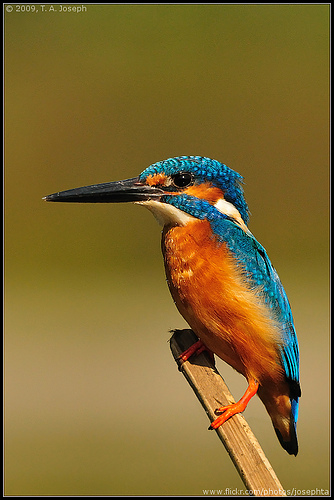
Small Blue Kingfisher


Images Source : Internet
There are many more birds of Chennai. You can check the list of birds of Chennai in this link : en.wikipedia.org/wiki/

Keep exploring about the birds around your place and have a touch with our biodiversity to know about the hidden values of our environment.

Thanks for reading :)

15 December 2012

Decline of Sparrows - Much hyped and to be concerned issue


Sparrows - A small passerine(denoting birds of large order, it also includes all song birds in this group) bird which is also called as House sparrows, True sparrows..  Native of this birds are Asia, Europe & Africa.. But they were found almost everywhere in the world..But surprisingly their population has seen a sharp decline in the past few years..There are many reasons for this decline..After many researches the exact reason is yet to be found..


Causes for the vanishing sparrows :


Let us know about some featured reasons :

                         ~ Radiations from mobile & television towers.

                         ~ Inadequate food.

                         ~ No sufficient place to build their nest.

                         ~ Rapid urbanization and industrialization.

                         ~ Few green cover i.e. lack of trees.
                     
                         ~ Birds poaching - is one of the reasons that has to be taken on a deep note.

                         ~ A new research has found noise pollution as one of the cause for this decline.


             Of all these, inadequate food and insufficient place to build nest were commonly debated on. As of the new research, the modern houses and buildings without holes or rooftop shelves made hard for these small chirping birds to build their nests.. As noise pollution plays spoilsport for these birds, it has been said by the researchers that parent bird couldn't hear its younger one calling for food. They found that birds living in a quiet place are fed more than that reside over a noisy area.. Another cause is that the emission of carbon-mono-oxide from vehicles affect these birds badly..


Recovering steps to get these sweet chirping sparrows back :

               On a keen willingness to witness these birds again, with sufficient food grains and proper surroundings, it is possible to bring them back.. First step is that we must make sure to grow some plants and trees in our garden or in some social areas like schools, private or public concerns.. Then providing some wooden nest boxes near trees or in a terrace could ensure a place for the House sparrows to live in.. You can also spread some grains on the terrace and provide a bowl of water to invite these small visitors.. Keeping some water in your terrace for birds will be most valuable during summer seasons..


Images Courtesy : Internet
               You can also have some hanging pots filled with food grains in your veranda or balcony to feed birds.. The main advantage of having a hanging pot is that it makes sure that birds are safe from cats or dogs that would often hurt them when have their food in the ground.. Apart from this, as birds always love to swing and sit at higher places, hanging pots would invite them with joy..


           By bringing all these measures in effective action we can not only get these small sparrows back, but also we can get back the diminishing mynas and many other birds.. By maintaining the lakes, estuaries and wetlands in a city, we can get back the birds of their habitats..

 Madras Naturalist Society ( MNS ), a non-profit organisation based in Chennai.. It is maintained by a group of nature lovers who are involved in many activities on birds and several other activities related to nature.

I would like to share some of the MNS activities related to sparrows here.Have a look on the following articles which depicts the ways to get back the sparrows..


             >   http://www.thehindu.com/news/cities/

World's Sparrow Day is celebrated across the globe on 20th of March every year to create a public awareness about the decline of sparrows. The main theme of the World Sparrow Day that has been said in their website worldsparrowday.org  is  
                 "CHIRP FOR THE SPARROW ! TWEET FOR THE SPARROW "
As many bird lovers are doing their part in such issues, people are less aware about that.. Let us take  it to limelight to save these small birds..

Thanks for reading.. Do share about this to your people around...